Three ships. Three philosophies. One question: What kind of world survives four hundred years of nothing?
This experience is based on the work of Project Hyperion — a generation ship design competition organized by the Initiative for Interstellar Studies. The three ship designs explored here are the competition's winning entries.
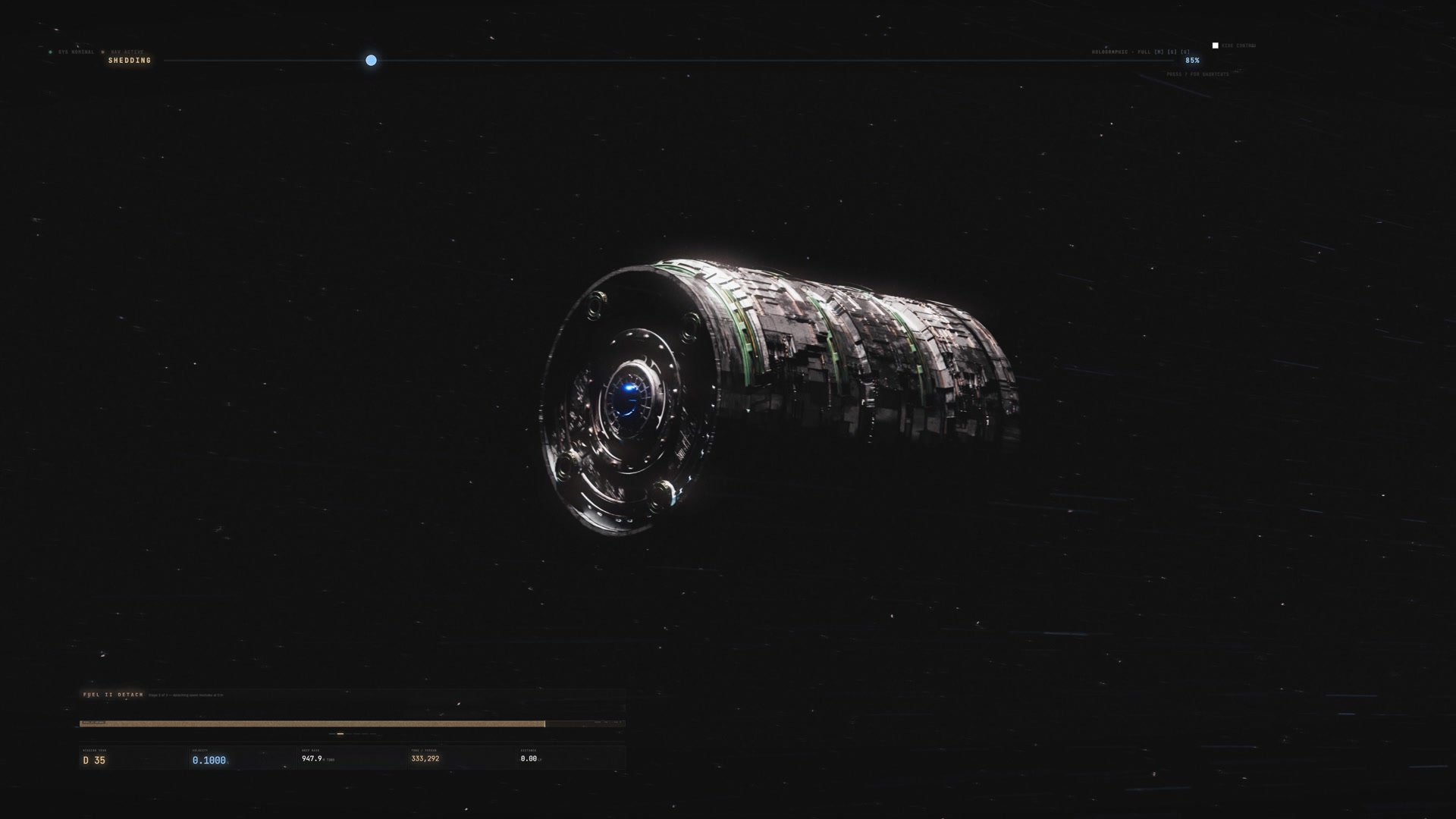
All ship renders and visualizations by Nolli Studio — our interpretations of each design based on the available competition material.
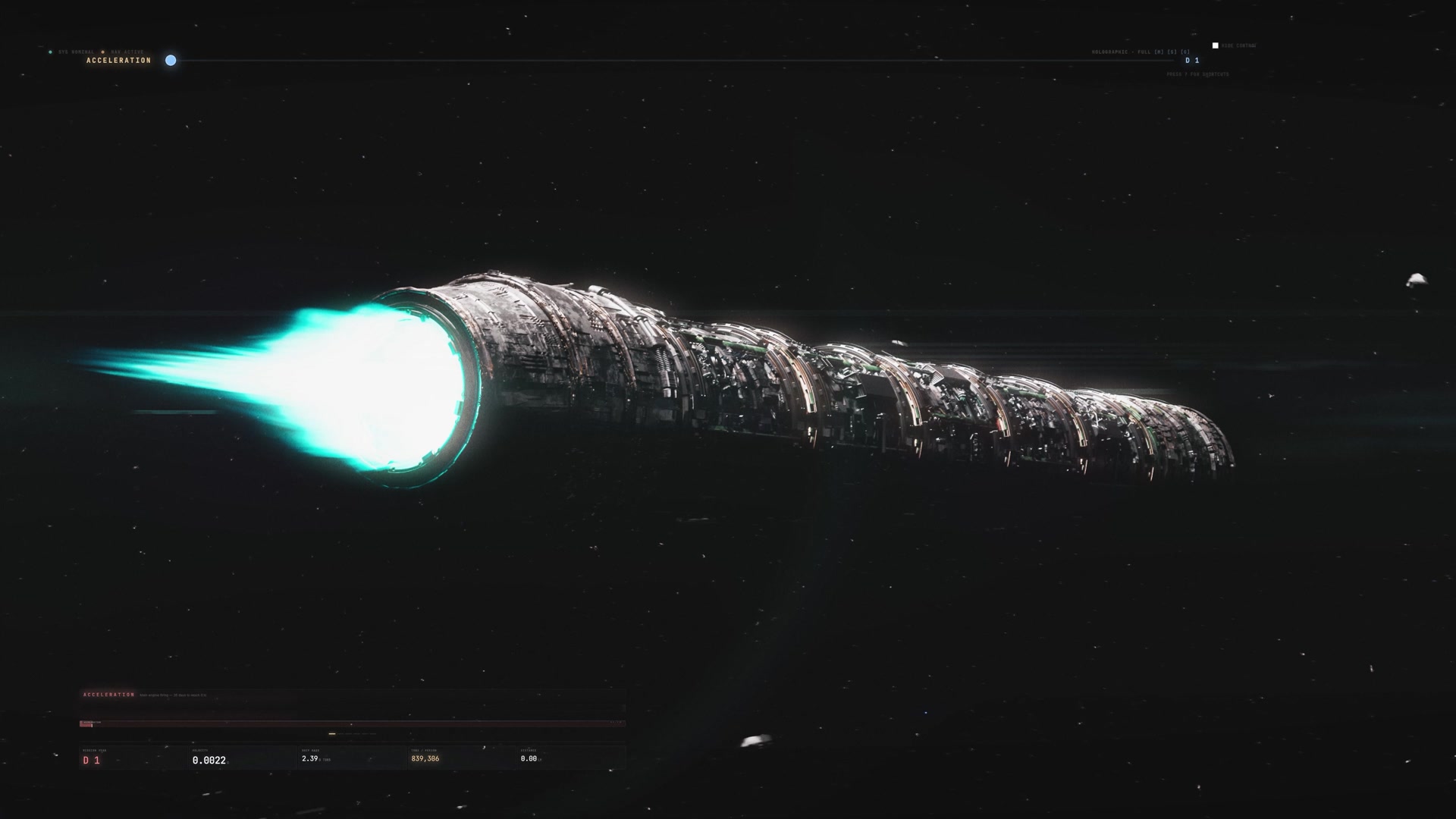
We build vehicles to get somewhere. But what do you build when arriving is not the point? What happens when you're designing not a spacecraft, but a civilization — a world that will exist in transit longer than any nation-state has existed?
The generation ship represents a uniquely humbling inversion of human engineering. Every bridge is built with the expectation that its designers will cross it. Every city is built by those who will live in its streets. But a generation ship is built by people who will never see its destination, by engineers who will die before their own blueprints are half-realized.
This constraint is not a failure of foresight. It is the essential question. It asks: what is the minimum artifact that can carry not just people, but meaning, across four hundred years in the dark?
The three designs explored here — Chrysalis, Proximum, and the Wolverine Fleet Project — represent three different bets on what kills civilizations: complexity, forgetting, or loss of agency. Each design is an opinion about human nature under extreme conditions. Each is a different answer to the same terrifying question: Can we build a world that doesn't need us?
The distance to Proxima Centauri is 4.24 light-years. This is not a poetic number. This is 40 trillion kilometers, or roughly 268,000 times the distance from Earth to the Sun.
At 0.1c — one-tenth the speed of light, the assumed cruise velocity for a near-future generation ship — this journey takes 42.4 years. But that is the raw travel time. It does not account for acceleration, deceleration, or the engineering reality that reaching and maintaining 0.1c requires energy systems that do not yet exist.
Voyager 1 (launched 1977) is the fastest human-made object at 17 km/s — it would reach Proxima Centauri in 73,000 years. The Parker Solar Probe reaches 191 km/s, nearly 11 times faster. At Parker's speed, the journey would take 6,900 years. 0.1c is 30,000 km/s — roughly 157 times faster than Parker Solar Probe.
| Metric | Value | Context |
|---|---|---|
| Earth to Sun | 1 AU / 150M km | Baseline reference |
| Voyager 1 speed | 17 km/s | Actual current spacecraft |
| Parker Solar Probe | 191 km/s | Fastest human object to date |
| 0.1c cruise speed | 30,000 km/s | Project Hyperion target |
| Time to Proxima at 0.1c | 42.4 years | Travel time only |
Project Hyperion itself was a real design study conducted by the British Interplanetary Society and Icarus Interstellar between 2009 and 2014. The design brief specified 0.1c cruise velocity and a 40-year transit to Proxima Centauri b as hard constraints. These are engineering targets, not fantasy — difficult, but not thermodynamically impossible.
Every generation ship design is fundamentally an exercise in constraint stacking. These are not challenges you solve and move past. They are conditions you live with.
Humans evolved in 1G. We don't actually know the minimum artificial gravity a population needs to remain healthy over generations. At 2 RPM rotation, you need a minimum radius of about 225 meters. Coriolis effects cause nausea, disorientation, and vestibular damage. Too small a radius, and your inner ear cannot adapt.
Rotation threshold: 2 RPM maximum for extended habitation
Minimum radius: 225 meters for comfortable sustained gravity
G-force achievable: At 2 RPM and 225m radius: ~0.7G
Earth's magnetosphere is invisible until you leave it. A Mars mission exposes astronauts to ~300 mSv. A 42-year transit accumulates doses an order of magnitude higher. Options range from mass shielding (meters of water/regolith) to magnetic shielding (superconducting mini-magnetosphere).
Earth cycles carbon, nitrogen, and water across millennia. A generation ship must achieve the same in cubic kilometers. Biosphere 2 tried and failed to maintain stable atmospheric composition after 16 months. ESA's MELiSSA project takes a modular approach: bacteria decompose waste, algae fix CO₂, plants provide food — a cascade of manageable loops.
The "Tasmanian Effect" describes how Tasmania, isolated for 10,000 years, gradually lost bone tools, fishing equipment, and cold-weather clothing. In small populations, knowledge loss exceeds knowledge gain. Skills degrade faster than they accumulate.
Whom do you send? What happens when you optimize for specific traits and then seal 500 people in a box for 42 years? Do you select for genetic diversity or psychological resilience?
Redundancy as philosophy. Five worlds, one mission.
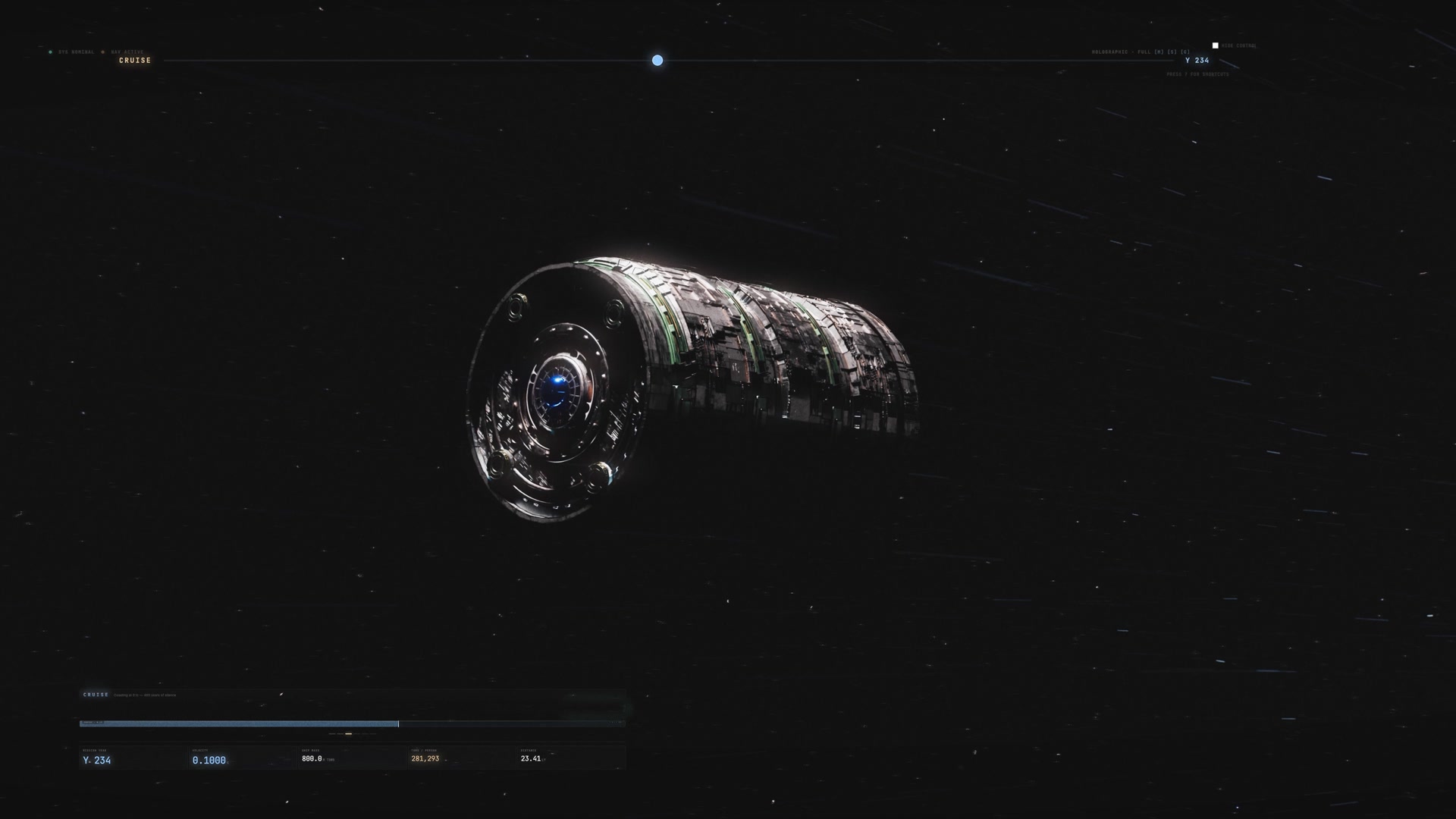
Chrysalis is redundancy as philosophy. Five independent rotating habitats, nested inside each other, each capable of supporting human life independently. If one stage suffers catastrophic failure, the other four seal and continue. The ship survives through amputation.
Each stage has independent propulsion, life support, power generation, and command systems. Graceful degradation means the system continues functioning as components fail, rather than catastrophic collapse.
Rather than one massive shared world, five independent worlds, each the size of a small city. Gravity shafts allow residents to move between stages. Each stage develops distinct culture, governance, and social norms.
The five stages connect through a central non-rotating axis — a 200-meter tube running the full 58km length. It contains transport, communications, energy distribution, and backup life support. Where each rotating stage meets the axis are interface shells — where Chrysalis becomes a Swiss watch.
You have 500 seats on Chrysalis. You have 8 billion applicants. What is your selection function?
Cameron Smith's research estimates the minimum viable population without genetic intervention at 10,000-40,000 people. With a global gamete bank, that drops to 98-500 — exactly the scale of a single Chrysalis stage.
Historical examples abound: every Afrikaner with Huntington's disease traces to a single colonist, Jan van Riebeeck, in 1652 — one man, 370 years ago, responsible for 5,000+ cases today.
Minimal viable population (no tech): 10,000–40,000
With gamete bank: 98–500
Genetic drift effect: ~1–2% of alleles lost per generation in a population of 500
HLA diversity loss: 40–60% in first generation without selection
You cannot put a thousand type-A, high-achieving, competitive individuals in a box for life. You need high agreeableness, emotional stability, conscientiousness, boredom tolerance — but also enough diversity of worldview to prevent groupthink.
Survival through scale. A world inside an asteroid.
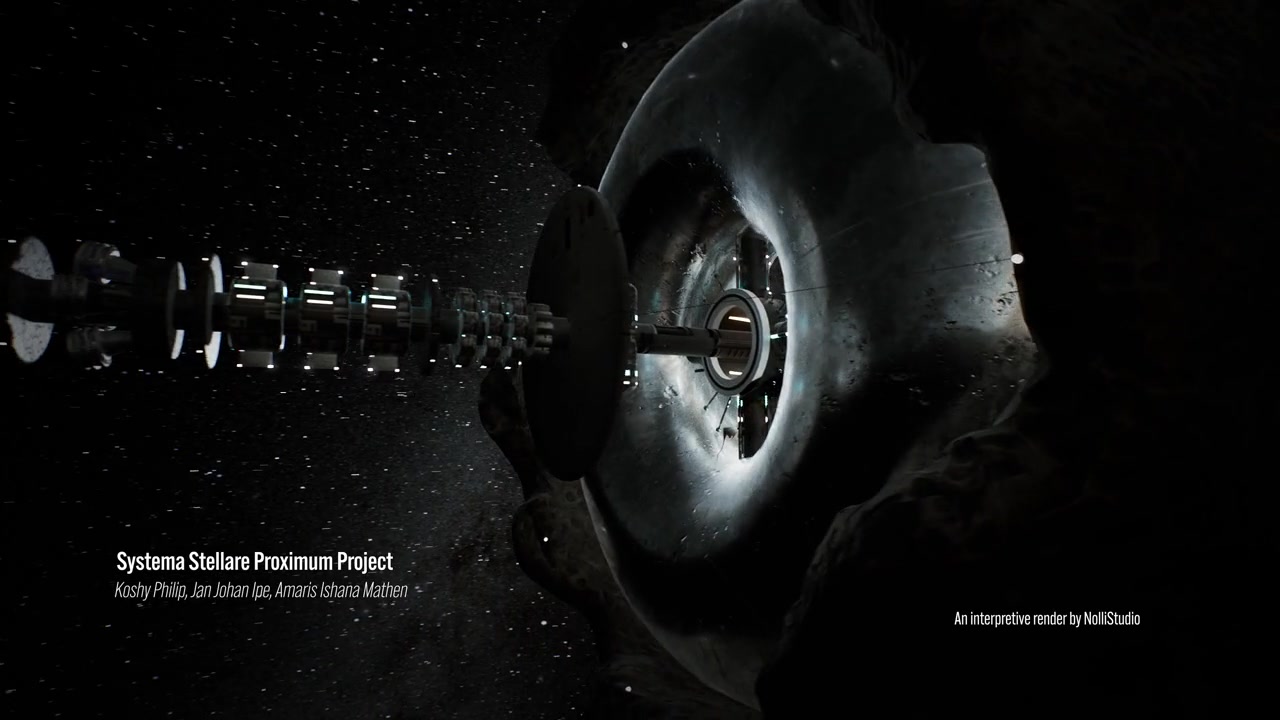
If Chrysalis is redundancy through isolation, Proximum is survival through scale. It houses 10,000 people in two counter-rotating habitats suspended inside a hollowed asteroid. It is more than a ship; it is a world.
Two habitat rings spin in opposite directions at 2 RPM each. The angular momentum vectors cancel — zero net spin. This eliminates gyroscopic precession without active correction. Physics does the work.
Angular momentum of ring 1: L clockwise
Angular momentum of ring 2: L counterclockwise
Total system angular momentum: 0
Structural stress: Dramatically reduced vs. single rotating habitat
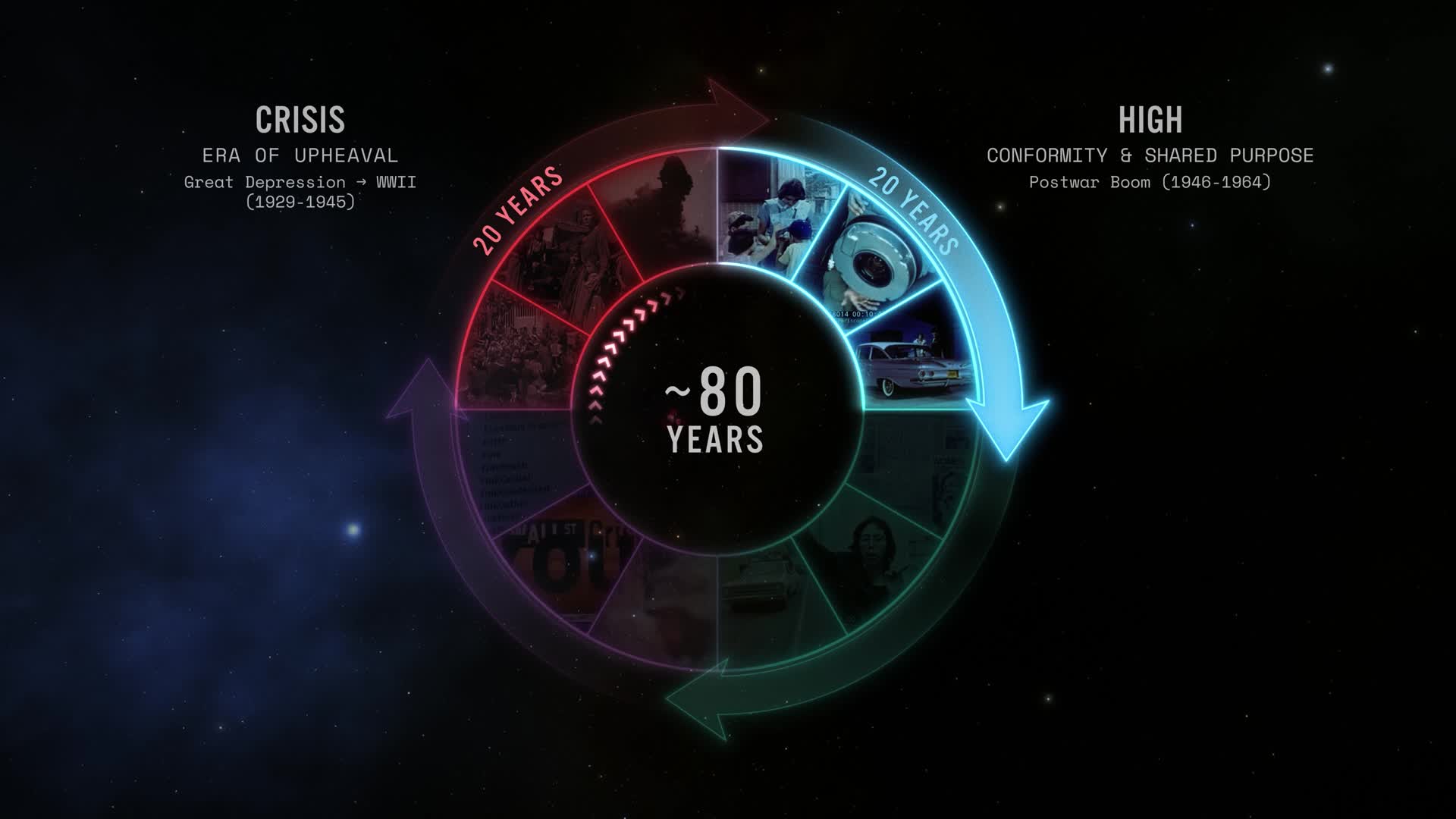
Proximum's governance is built on a theory of social cycles: The Fourth Turning by Strauss and Howe. History moves in ~80-year cycles: Crisis → High → Awakening → Unraveling → Crisis. Over 400 years, Proximum faces five complete cycles.
The critical insight: you cannot prevent the cycle. Every generation fails to learn the lessons two generations back. Knowledge dims. Institutions corrupt. Crisis emerges. But if you know this is coming, you can structure governance to survive it.
Four American cycles of Crisis → High → Awakening → Unraveling
"They deliberately launch right after a crisis, during a high — when trust in institutions is strongest and living memory of collapse still shapes policy."
— SS Proximum Mission PlannersApollo is an AI. But it is not the decision-maker — it is the memory. It models consequences of proposed policies: food, health, resources, social cohesion. It returns scenarios, not recommendations.
Apollo's scenarios are only presented when multiple independent copies agree — Byzantine Fault Tolerance. Distributed hardware prevents single-point failure or corruption.
Elected representatives making day-to-day decisions — informed by Apollo but not determined by it. Politicians can ignore Apollo's warnings, but they must do so in public. The prediction is recorded. Accountability through time.
At age 65, members can enter hibernation and be periodically revived as advisors. Data can recall that a famine happened. But it cannot convey what it felt like to ration food to your children. The Chorus carries lived memory across centuries.
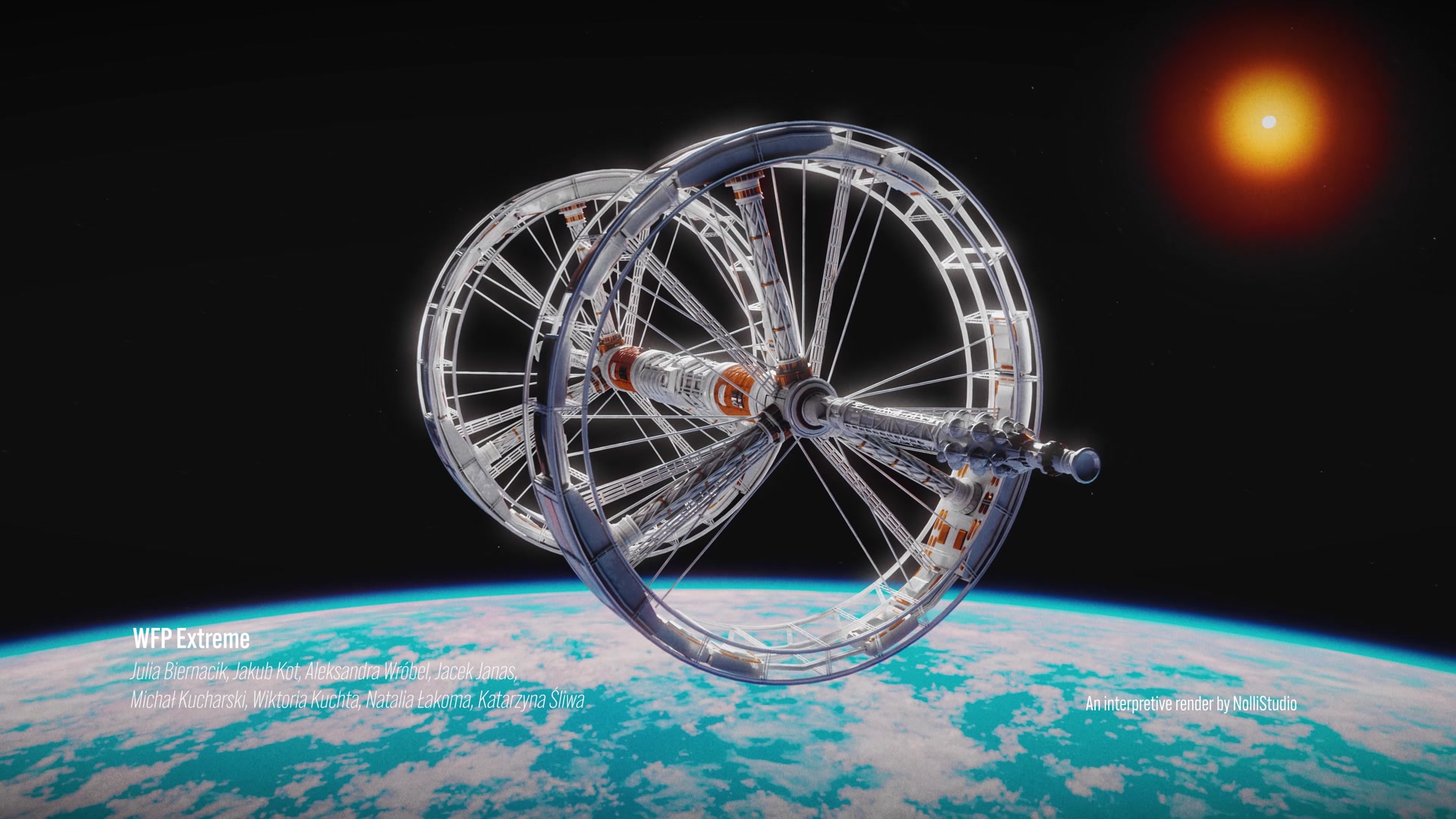
Small. Modular. Self-assembling. Impermanent by design.
WFP is 1/300th the length of a single Chrysalis stage. Each ship is roughly the size of a WWII aircraft carrier. The entire fleet carries 10,000-20,000 people — comparable to Proximum, but distributed across far smaller units.
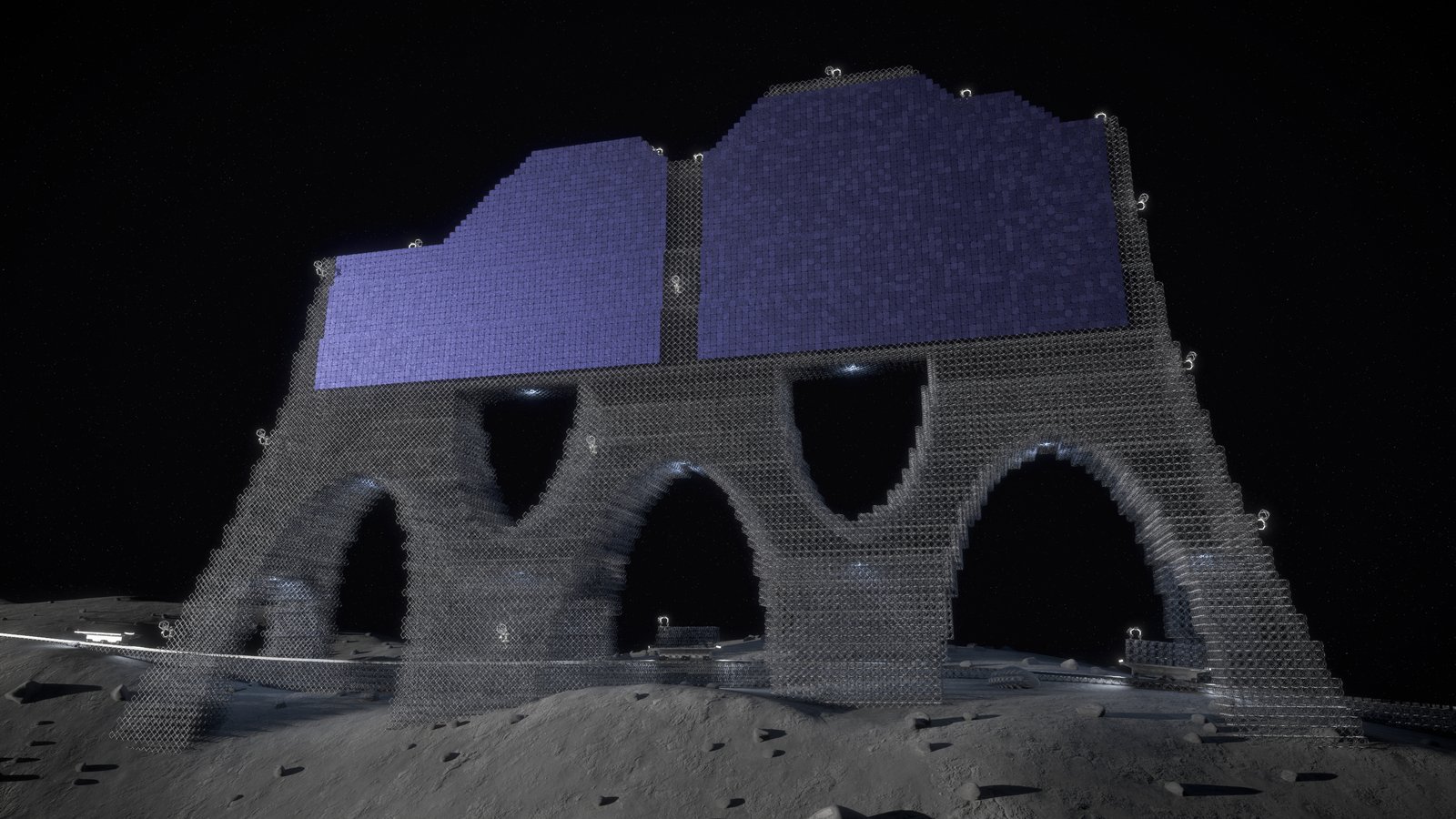
Unlike Chrysalis or Proximum, WFP has no external shell. The habitat modules themselves are the protection. Each is built from a single repeating unit — a triangular module that integrates thermal insulation, structural support, pressure containment, acoustic control, and radiation shielding into one element. No specialized parts. No custom fabrication. One geometry, endlessly repeated.
Dimensions: 7.4m per edge — optimized for orbital assembly
Each module contains: Thermal insulation, structural support, pressure containment, acoustics, radiation shielding
Assembly: Robotic or autonomous — no human EVA required
Replacement: Any module can be reproduced onboard during transit
In orbit, these modules click together — either guided by robots or entirely on their own. This is not speculative. The concept draws directly from MIT's Self-Assembly Lab, founded by Skylar Tibbits in 2014. The lab's research in programmable matter demonstrates that materials can be engineered to connect, fold, and organize without human intervention. WFP scales that principle from tabletop experiments to orbital construction.
Everything about WFP is designed around impermanence. The ship exists in three phases: modules assemble in Earth orbit to become the vessel. During transit, that vessel is home. Upon arrival, the modules detach, descend, and become the first colony structures on the surface. The ship's skeleton becomes an orbital satellite, surveying the new world. Nothing here is meant to be permanent.
And because the ship carries full-scale recycling and production facilities, any broken component can be remade in transit. The population can grow; the ship grows with it. WFP is not a static artifact — it is a living system that remakes itself continuously over four hundred years.
John Turner spent decades studying self-built housing. In the 1960s, he found that residents relocated from Peru's favelas into superior government housing were miserable. They hadn't chosen or built these homes. But residents who built imperfect homes in the favelas reported higher satisfaction.
Building your own shelter generates meaning independent of the shelter's material quality. Housing is not a noun — it is a verb, an ongoing process.
WFP embodies this. Neighborhoods form organically. Modules are generic; communities shape them. Zero-gravity crossing zones between rings become meeting places, markets, gathering points.
The competition entries for Project Hyperion were submitted as technical documents — diagrams, cross-sections, engineering specifications. Beautiful in their precision, but constrained by format. We wanted to see what these designs could become when freed from the page.
Using Unreal Engine and Blender, the Nolli Studio team set out to interpret each project as a cinematic experience. Every ship, every habitat, every structural detail was reconstructed from the available drawings and descriptions — a process that required equal parts engineering research and creative intuition. Where the documents ended, our best judgment began.
This was never about replacing the original designs. It was about revealing something that a presentation format cannot: the sheer beauty and ambition of what these teams imagined. A diagram of counter-rotating tori becomes a world you can fly through. A schematic of connected stages becomes a cathedral in the void. We took these projects to a different light — not to make design decisions, but to let a wider audience appreciate what was always there.
Every asset was built by hand — modeled, textured, lit, and rendered without the use of generative AI. This was a deliberate choice. The integrity of each design depends on structural logic: how a habitat connects to a hull, how gravity dictates form, how engineering constraints shape architecture. Generative tools cannot reason about these relationships. Authenticity mattered more than speed, so every detail traces back to a human decision grounded in the source material.
Raffaele di Nicola
Wisdom Whyte · Lucas Chan · Felipe Lazo · Devin Wu · Mehmet Abdelhadi · Sam Ma · Pablo Yanez